
With its foray into self-drive, Ola will go head-to-head with early entrants Zoomcar, Revv and a few other.

The production-linked incentive (PLI) scheme for the automobile sector has created market distortions, excluded innovation-led electric two-wheeler (e2w) makers, and failed to convert cost advantages into export competitiveness, with 77 per cent of export volumes driven by non-PLI models, said a report released by the Centre for Domestic Economy Policy Research (C-DEP) on Friday.

The new Ola app will allow fleet owners to track their cars in real-time, view the performance of their drivers, and even their daily earnings

Leading Indian electric two-wheeler (e2W) companies have said that "swapping" of batteries is currently unviable and will only increase the cost for a consumer to run the vehicle.

'We handle close to 3 million rides daily, making us one of the largest players in this segment'

As a tech services company, Ola has never been in hardcore manufacturing. And unlike in ride hailing, which is a two-player market (Uber is the only other competitor), in two-wheelers it faces many entrenched players. But most of all, rivals say Ola's targets are out of sync with most, even ambitious, projections.
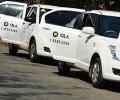
The state government says Ola was using its existing cab aggregator licence to promote bike taxi services.

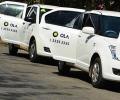
About 1,000 such cabs have been registered on the company's platform so far

The development comes close on the heels of Uber planning to invest substantial part of $3.5 bn Saudi money in India.

US-based ride hailing firm accuses rival of making false bookings on its platform, drags it to Delhi High Court.

By 2025, Uber projects that 25,000-30,000 cars -- or 12 to 16 per cent of vehicle additions -- would be EVs, reports Surajeet Das Gupta.

Just a few weeks ago, the Centre has come out with the long-awaited Motor Vehicle Aggregator Guidelines, which have drawn a dismayed response from the companies concerned.

There are times when a customer books a cab and is charged for the ride, but the driver doesn't show up. It is one of the many hacks that cab drivers use.
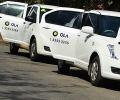
There are about 600,000 taxis in India, generating combined annual revenue of about Rs 11,000 crore (Rs 110 billion).

Nearly a decade ago, the first fully electric vehicle (EV) caught fire on the road in the US. It was a model from Tesla, the world's most admired EV maker. A metal fragment punctured the underbelly of the vehicle, penetrating its battery pack, leading to a fire. Indian lawmakers and automakers have had nine years to study the incident (in fact, three Tesla Model Ss caught fire in two months in 2013) but seem to have learnt little.

The aim is to replace nearly 40 per cent of its existing last mile fleet of delivery vans with EVs by March 2020. o start with, the company is looking at deploying nearly 160 e-vans by the end of 2019.
Vogo, which has a fleet of over 12,000 vehicles mainly across Hyderabad, Mysuru and Bengaluru, is also betting big on India's growing traffic congestion.

The capital infusion is expected to bolster its presence in the country by funding its key businesses to take on Indian rival Ola.
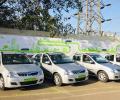
Mahindra launches e-mobility platform 'Glyd' to take on Ola, Uber. Targeted at office-going executives, it offers web-conferencing, curated entertainment and music content from selective partners.

With Kona catering for the high-end market, the South Korean automobile conglomerate wants to introduce a product in the EV segment to address the mass segment.

Uber would look to expand the service to six Indian cities

Meru Cabs' founder says they were a traditional company.

Radio taxi service provider Meru Cabs is planning to put in place the next level of driver verification, one liked to biometric identification tool Aadhaar.

The company is a facilitator of taxis (therefore an intermediary) and is best governed under the IT Act said Neeraj Singhal, Uber's head of expansion in India.

The amendment comes within a month of web-based taxi companies being banned in Delhi, after a taxi driver on Uber's network allegedly raped a finance executive early this month.
Meru Cabs and OlaCabs among radio cabs and bus ticket booking provider Redbus have been using big data analytics.

Unlike regular cab service providers, taxi aggregators like Uber and Ola are making it easy for the students to juggle work and studies.

Under the new rules, Karnataka has mandated ride hailing start-ups to provide digital printers, install panic buttons and have taxi signage on their vehicles.

Corporate ministry documents show that the Siva's firm kept taking loans from public sector banks like State Bank of India, Punjab National Bank which gradually turned to bad loans.

With Uber dipping into its generous war chest to subsidise its service, its pampered clientele should sit back and enjoy the ride.

Swiggy, a Bengaluru-based food ordering and delivery start-up, says it aims to revolutionise this segment.
The safety net for passengers is focused solely on the terms and conditions for the radio taxi scheme issued by the transport department.

A number of Xooglers are employing lessons and practices learnt during their stint at Google to branch out into innovative ventures.

India'sstartups have a good beginning but will they survive competition is a big questions which needs immediate attention.
 © 2026 Rediff.com - Advertise with us - Disclaimer - Privacy Policy - Sitemap - Feedback - About us - Terms of use - Grievances